
Receiving DMEPOS accreditation is an important milestone for any durable medical equipment supplier. However, accreditation does not mean that a business has completed all its Medicare compliance responsibilities. Suppliers must continue meeting federal requirements, maintaining operational standards, and protecting their Medicare billing privileges.
For DMEPOS businesses in the United States, understanding the difference between accreditation and Medicare compliance is essential. Both play important roles in maintaining eligibility, delivering quality patient care, and avoiding costly regulatory problems.
Understanding DMEPOS Accreditation and Medicare Compliance
Although these terms are closely connected, they serve different purposes.
What Is DMEPOS Accreditation?
DMEPOS accreditation is an independent evaluation conducted by a CMS-approved accreditation organization. It verifies that a supplier meets applicable Medicare DMEPOS Quality Standards.
The accreditation process generally evaluates:
- Patient care and service quality
- Business operations and documentation
- Equipment management and maintenance
- Complaint management procedures
- Staff qualifications and responsibilities
- Supplier policies and operational practices
Accreditation demonstrates that a supplier meets the applicable quality requirements. However, suppliers must continue maintaining those standards after approval.
What Is Medicare Compliance?
Medicare compliance involves meeting the broader regulatory and enrollment requirements established by the Centers for Medicare & Medicaid Services (CMS).
These responsibilities include maintaining accurate enrollment information, appropriate licensing, supplier standards, documentation, and Medicare billing practices.
A supplier may maintain accreditation but still experience Medicare enrollment or billing problems if other requirements are neglected.
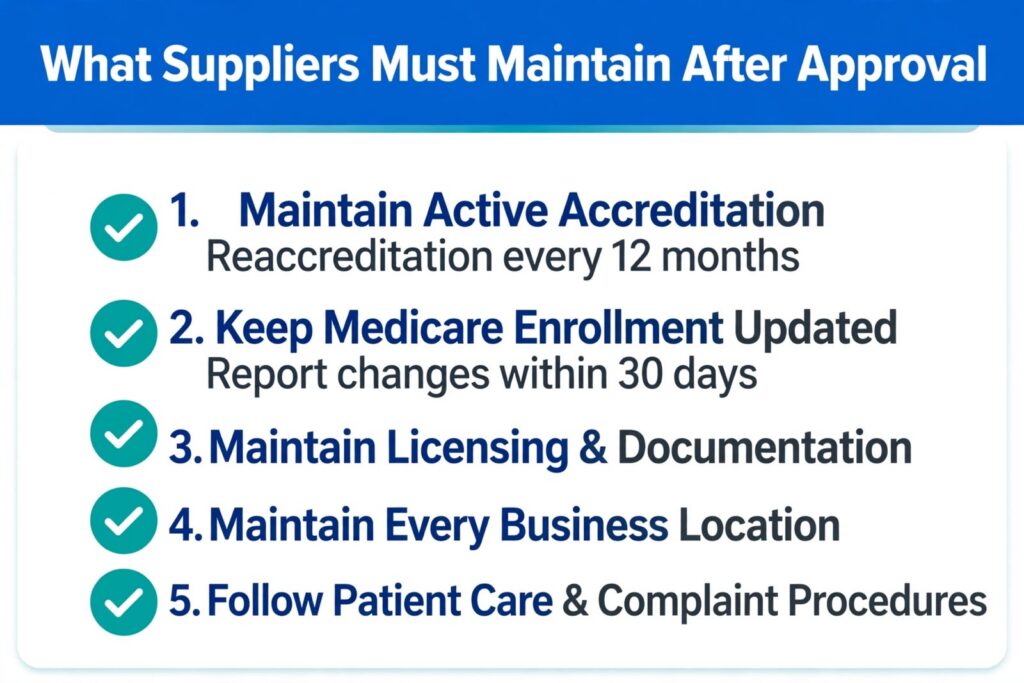
What DMEPOS Suppliers Must Maintain After Approval
Maintaining compliance requires ongoing attention rather than occasional preparation before an accreditation survey.
1. Maintain Active Accreditation
Suppliers must maintain accreditation through a CMS-approved organization and ensure that their accreditation covers the specific products and services they provide.
CMS introduced important changes effective January 1, 2026, including a requirement for surveys and reaccreditation at least every 12 months. Suppliers should coordinate with their accreditation organization to understand their applicable survey schedule and transition requirements.
2. Keep Medicare Enrollment Information Updated
Business information must remain accurate in Medicare enrollment records.
Suppliers should review:
- Business ownership information
- Authorized officials
- Practice locations
- Contact information
- Tax identification details
- Products and services offered
Changes to enrollment information generally must be reported to the National Provider Enrollment DMEPOS contractor within 30 days.
3. Maintain Proper Licensing and Documentation
DMEPOS suppliers must maintain all applicable state and local licenses required for their business activities.
They should also organize business records, patient documentation, employee files, supplier agreements, and operational policies.
Proper documentation helps demonstrate compliance during reviews, surveys, and Medicare audits.
4. Maintain Every Business Location
Medicare compliance applies to individual supplier locations, not simply the company’s main office.
Each applicable location must meet the required quality standards and accreditation requirements. Suppliers opening additional locations should notify their accreditation organization and complete the necessary accreditation and enrollment steps.
5. Follow Patient Care and Complaint Procedures
Patient satisfaction and safety remain important after accreditation approval.
Suppliers should maintain clear procedures for handling complaints, responding to service issues, documenting resolutions, and ensuring that patients receive appropriate equipment and support.
Common Compliance Mistakes After DMEPOS Approval
Even established suppliers can experience compliance problems because of weak internal management.
Common mistakes include:
- Allowing accreditation requirements to lapse.
- Failing to report business changes on time.
- Operating additional locations without proper accreditation.
- Keeping incomplete patient or business records.
- Providing products outside approved accreditation categories.
- Ignoring corrective actions identified during surveys.
- Failing to monitor Medicare billing requirements.
These mistakes can lead to enrollment complications, denied claims, or potential revocation of Medicare billing privileges.
How to Build a Strong DMEPOS Compliance Program
A proactive compliance program helps suppliers maintain their accreditation and Medicare eligibility.
Businesses should conduct regular internal reviews, assign compliance responsibilities, train employees, update written policies, and monitor regulatory changes.
Working with experienced DMEPOS compliance professionals can also help identify operational gaps before they become serious problems.
Conclusion
DMEPOS accreditation and Medicare compliance are connected, but they are not interchangeable. Accreditation confirms that a supplier meets applicable quality standards, while Medicare compliance requires continuous attention to enrollment, licensing, documentation, billing, and operational responsibilities.
For DMEPOS suppliers, maintaining both is essential for protecting Medicare billing privileges, supporting patient care, and building a sustainable business.
Frequently Asked Questions (FAQs)
1. Is DMEPOS accreditation the same as Medicare compliance?
No. Accreditation evaluates compliance with applicable DMEPOS Quality Standards, while Medicare compliance covers broader enrollment and regulatory responsibilities.
2. Do DMEPOS suppliers need to maintain accreditation after approval?
Yes. Applicable suppliers must maintain accreditation through a CMS-approved organization to retain Medicare billing privileges.
3. How often must DMEPOS suppliers be reaccredited?
CMS established a survey and reaccreditation requirement of at least once every 12 months, effective January 1, 2026. Existing suppliers should confirm their applicable transition schedule with their accreditation organization.
4. What happens if a DMEPOS supplier fails to maintain compliance?
Depending on the violation, consequences may include corrective actions, claim denials, enrollment denial, or revocation of Medicare billing privileges.
5. Do new DMEPOS locations require separate accreditation?
Yes. Applicable owned and subcontracted supplier locations must meet quality standards and be separately accredited to bill Medicare.
6. How can suppliers maintain Medicare compliance?
Suppliers should regularly review enrollment information, maintain documentation, monitor licensing, follow patient care standards, and prepare for accreditation surveys.