
For DMEPOS suppliers, compliance is an ongoing responsibility that affects patient services, Medicare enrollment, documentation, and business operations. Missing records or outdated procedures can create avoidable challenges when an accrediting organization reviews a supplier’s practices.
The best way to prepare is to build a compliance system that works every day—not just when a survey is approaching. Suppliers should know where important records are stored, who is responsible for maintaining them, and how their staff demonstrate compliance with applicable requirements.
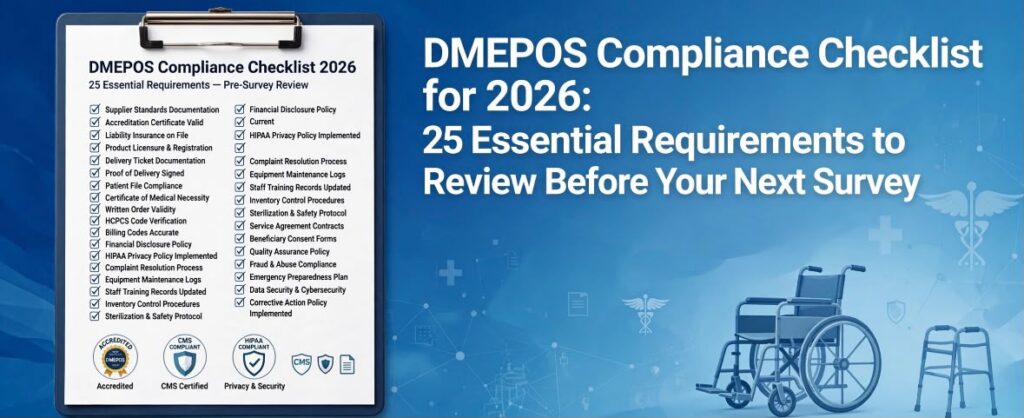
This DMEPOS compliance checklist for 2026 covers 25 areas that suppliers should review to strengthen their preparation, improve documentation, and identify potential gaps before they become more serious.
Understanding DMEPOS Compliance Requirements in 2026
DMEPOS stands for durable medical equipment, prosthetics, orthotics, and supplies. Suppliers seeking Medicare reimbursement must meet applicable enrollment requirements and, unless exempt, obtain accreditation from a CMS-approved organization.
CMS’s 2026 accreditation changes also make it important for suppliers to understand their applicable survey and reaccreditation schedule. Existing suppliers should check the transition provisions rather than assume that every accreditation certificate follows the same renewal date. .
The 25-Point DMEPOS Compliance Readiness Checklist
Use the following checklist to review your business’s documentation, responsibilities, and operating procedures.
Section 1: Business Identity and Regulatory Readiness
1. Verified legal business information
Confirm that your legal name, ownership details, business address, and organizational records are accurate. Investigate inconsistencies between internal documents and official records.
2. Current Medicare supplier enrollment
Review your enrollment status and confirm that required information is current in PECOS and with the applicable National Provider Enrollment contractor.
3. Location-specific NPI records
Verify the applicable National Provider Identifier information for each relevant practice location and ensure it corresponds with your enrollment arrangements.
4. State and local licensing requirements
Identify the licenses required for your product categories and locations. Keep copies of active licenses and a tracking system for renewal dates.
5. Surety bond compliance
Check whether your business is subject to Medicare’s surety bond requirements. Where applicable, confirm the bond amount, validity, and required enrollment-contractor information.
Section 2: Accreditation and Management Controls
6. Accreditation scope and status
Confirm that your accreditation covers the relevant locations and product categories. Keep your certificate, survey correspondence, and any conditions or corrective requirements together.
7. Survey and reaccreditation calendar
Maintain a calendar for survey preparation, accreditation deadlines, document reviews, and follow-up activities. Verify your schedule with the accrediting organization.
8. Assigned compliance responsibilities
Designate personnel to oversee enrollment records, patient documentation, billing controls, training, and operational policies.
9. Updated standard operating procedures
Review procedures to ensure they reflect actual business practices and applicable standards. Remove outdated instructions and document approved revisions.
10. Corrective action tracking
Maintain a record of identified deficiencies, required changes, assigned staff, completion dates, and evidence that corrective actions were effective.
Section 3: Patient Care and Service Quality
11. Patient communication procedures
Ensure staff know how to explain services, respond to questions, handle complaints, and communicate relevant information to beneficiaries.
12. Patient eligibility and order verification
Establish procedures for reviewing required orders and other applicable documentation before furnishing items or submitting claims.
13. Medical necessity documentation
Confirm that supporting records meet applicable Medicare coverage and documentation requirements for the items supplied.
14. Delivery confirmation and recordkeeping
Maintain proof of delivery and other required records showing what was furnished, to whom, and when. Apply the retention periods required for the relevant documents.
15. Complaint resolution procedures
Document complaints, investigations, outcomes, and corrective steps. Review recurring concerns to identify opportunities to improve patient service.
Section 4: Billing Integrity and Information Security
16. Coding and coverage verification
Review applicable HCPCS coding, coverage criteria, and documentation requirements before billing Medicare.
17. Pre-submission claim checks
Use a consistent review process to identify missing orders, unsupported claims, incorrect information, and other preventable billing issues.
18. Protected health information safeguards
Review access permissions, secure storage, staff responsibilities, and procedures for reporting and responding to privacy or security incidents.
19. Document access and retention controls
Make sure authorized personnel can retrieve records when needed while preventing unauthorized access, accidental loss, or inappropriate disclosure.
20. Billing issue and audit records
Keep records of internal billing reviews, identified errors, corrections, and follow-up actions. Escalate complex issues for appropriate professional review.
Section 5: Equipment Safety and Operational Reliability
21. Equipment maintenance documentation
Maintain relevant inspection, repair, and maintenance records for equipment your business supplies or services.
22. Inventory and recall procedures
Review stock management, product identification, returns, and processes for responding to defective or recalled products, as applicable.
23. Patient equipment-use instructions
Ensure beneficiaries receive appropriate instructions for equipment use, safety, care, and maintenance. Keep relevant documentation when required.
24. Delivery and after-sales service controls
Review procedures for delivery scheduling, repairs, service requests, returns, and responding to equipment-related concerns.
25. Staff readiness and evidence of implementation
Make sure employees understand the procedures relevant to their roles. Check that training records, policies, and actual work practices are consistent.
How to Turn the Checklist Into a Working Compliance System
A checklist is useful only when it leads to action. Assign each item to a responsible person and record whether the requirement is complete, needs improvement, or does not apply to your business.
Prioritize gaps that could affect patient safety, Medicare billing, licensing, or accreditation. Set realistic deadlines and retain evidence of completed corrections.
A practical review cycle can include:
- Monthly: Check expiring licenses, document gaps, complaints, and open corrective actions.
- Quarterly: Review a sample of patient files, billing records, employee training, and operating procedures.
- Before a survey: Confirm that relevant records are accessible and employees understand the processes they perform.
- After a regulatory update: Determine which requirements affect your business and revise policies or training when necessary.
These intervals are suggested internal review practices, not universal CMS-mandated frequencies. Follow any specific deadlines or review schedules that apply to your supplier category.
What Should Suppliers Do When They Find a Compliance Gap?
Do not wait until the next accreditation survey to address a missing license, incomplete patient record, outdated policy, or recurring billing error.
First, identify the issue and determine which requirement applies. Then assign responsibility, establish a correction deadline, and document the action taken. If the problem involves Medicare enrollment, billing, patient safety, or a potential legal violation, seek appropriate professional guidance.
Suppliers should also verify requirements directly with CMS, their enrollment contractor, relevant state licensing authorities, and their accrediting organization.
Keep Your DMEPOS Business Prepared Beyond the Survey
Strong compliance depends on consistent management, accurate documentation, trained employees, and procedures that reflect daily operations. A survey-ready business should be able to demonstrate not only that policies exist but also that staff follow them.
By reviewing these 25 areas regularly, DMEPOS suppliers can identify weaknesses earlier, improve accountability, and build a more organized approach to accreditation and Medicare compliance in 2026.
Frequently Asked Questions
What documents should a DMEPOS supplier keep ready for a survey?
Relevant documents may include accreditation records, business and enrollment information, applicable licenses, policies, training records, patient documentation, written orders, proof of delivery, maintenance records, and corrective action evidence.
What is the difference between DMEPOS accreditation and Medicare enrollment?
Accreditation evaluates compliance with applicable quality standards through a CMS-approved accrediting organization. Medicare enrollment is a separate process involving the applicable enrollment contractor and required supplier information. Both must be addressed when applicable.
Are DMEPOS suppliers required to undergo annual reaccreditation in 2026?
CMS finalized annual resurvey and reaccreditation provisions with transition rules. Suppliers should confirm when the annual cycle applies to their existing accreditation rather than assuming that every certificate renews on January 1, 2026.
How can suppliers prepare employees for an accreditation survey?
Provide role-specific training, review relevant policies, ensure employees understand their responsibilities, and verify that actual practices match written procedures.
What should a supplier do if its enrollment information is outdated?
Review the relevant reporting requirements and submit required updates through the appropriate Medicare enrollment process. Confirm that information is accurate across applicable records.
Why are proof of delivery and written orders important?
They help establish that applicable documentation and delivery requirements have been met. Missing or incomplete records can affect claim support and create compliance concerns.
Should suppliers maintain a separate checklist for each location?
A location-specific checklist can help identify differences in licenses, accreditation scope, staffing, and operational records. Businesses with multiple locations should verify the requirements that apply to each one.
Can a supplier use the same compliance checklist every year?
A checklist can serve as a reusable framework, but it should be reviewed and updated as CMS requirements, state laws, accreditation standards, and business operations change.
What are the most common DMEPOS compliance gaps?
Potential gaps include outdated enrollment information, expired licenses, missing supporting documentation, weak record-retention practices, incomplete training records, and unresolved corrective actions.
Where can DMEPOS suppliers verify official Medicare requirements?
Suppliers should consult CMS guidance, applicable Medicare enrollment contractors, relevant state licensing authorities, and their CMS-approved accrediting organization.