
Starting a DMEPOS business requires more than setting up a company and choosing the medical equipment you want to supply. If you plan to serve Medicare beneficiaries, you may also need to complete accreditation, meet supplier standards, and satisfy Medicare enrollment requirements before billing for covered services.
One of the most common questions new suppliers ask is: How long does DMEPOS accreditation take in 2026?
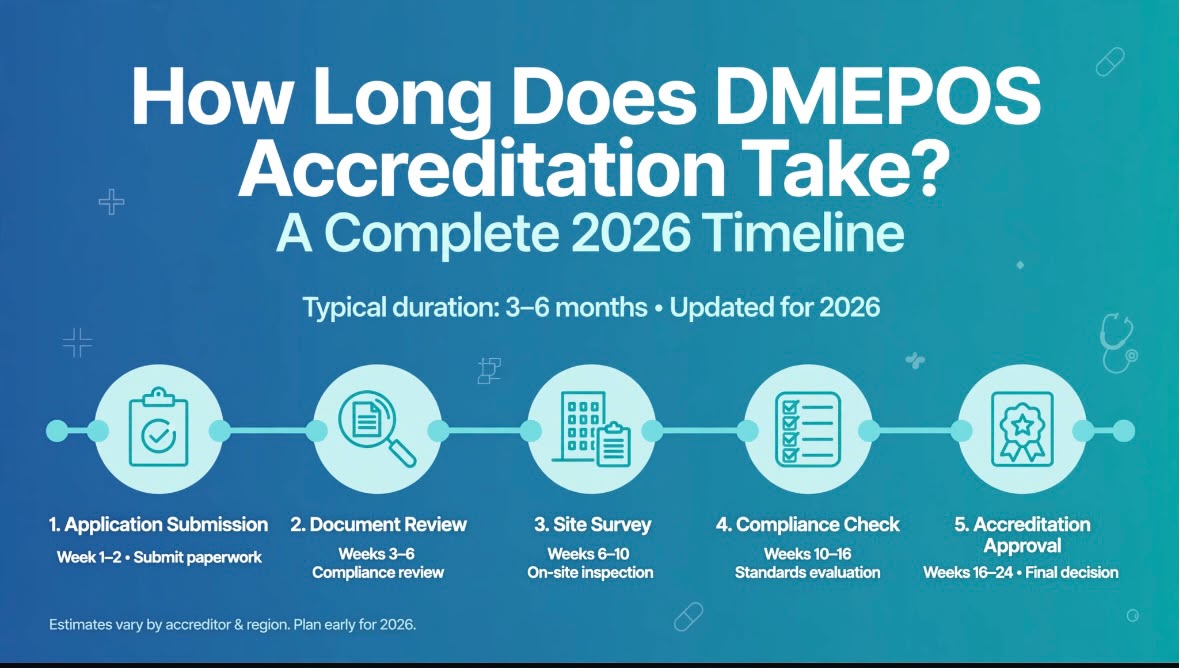
The answer depends on how prepared your business is, how quickly the accrediting organization can schedule and complete its assessment, and whether you need to correct compliance issues. There is no single official processing timeline that applies to every supplier.
In this guide, we explain the expected stages, preparation strategies, common delays, and important 2026 compliance considerations to help you plan your accreditation process.
What Is the Expected DMEPOS Accreditation Timeline in 2026?
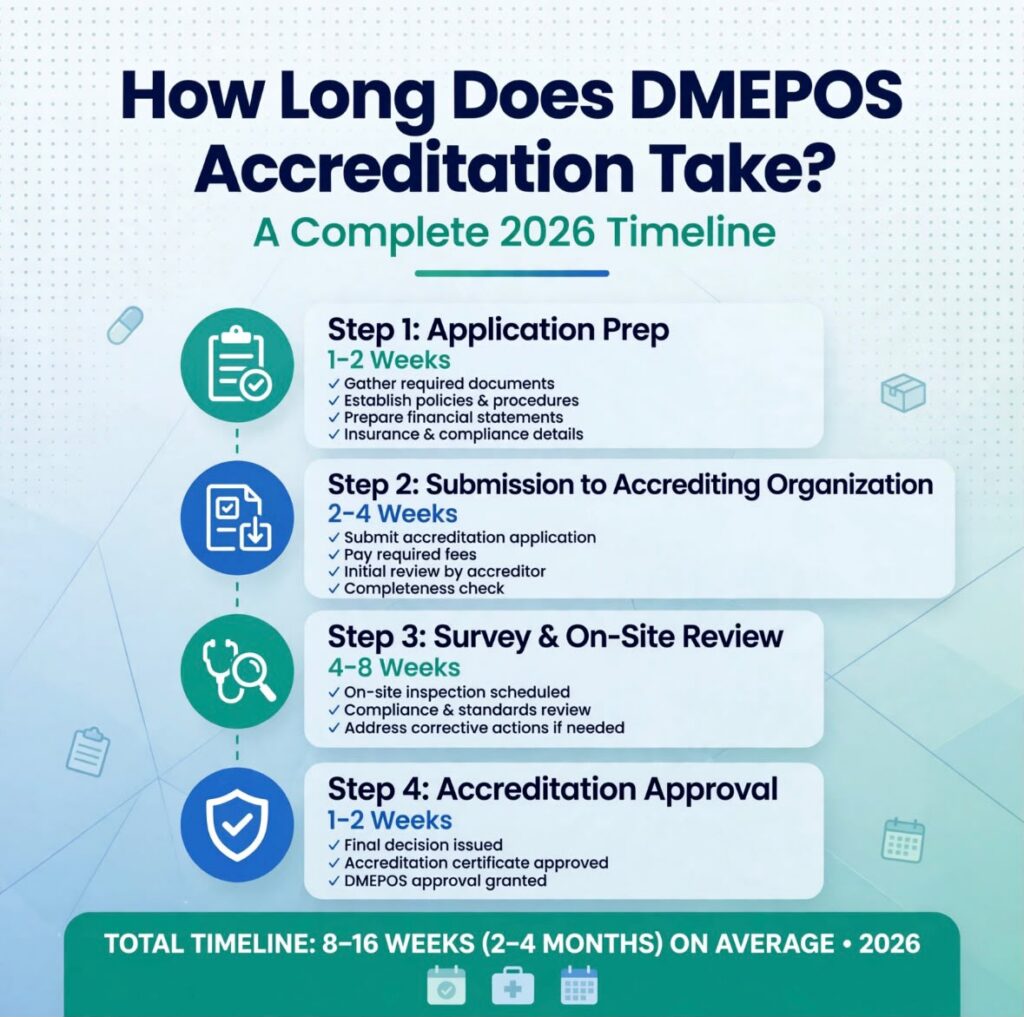
For planning purposes, suppliers should prepare for a process that may take several weeks to a few months. This is an estimate rather than a guaranteed turnaround time published by the Centers for Medicare & Medicaid Services (CMS).
The timeline generally depends on four factors:
- Business readiness: Whether your policies, staff records, licenses, and procedures are already in place.
- Application completeness: Whether the accrediting organization receives all required information.
- Survey scheduling: When an assessment can be conducted.
- Compliance findings: Whether deficiencies require corrective action or additional review.
A business that prepares thoroughly before applying may avoid preventable delays. However, even a well-prepared supplier must follow the accrediting organization’s process and wait for the required decision.
The Main Stages of DMEPOS Accreditation
1. Determine Your Accreditation Requirements
Before spending money on an application, identify the type of DMEPOS products and services your business will provide.
Your requirements may depend on your supplier category, business structure, locations, and applicable state regulations. Certain professionals and supplier categories may qualify for exceptions, so verify your specific situation with CMS or the Medicare enrollment contractor.
Start by identifying:
- The products and services your business will supply.
- Applicable state licensing requirements.
- The locations that require accreditation.
- Relevant Medicare supplier standards.
- Whether any exemption applies to your business.
Understanding these requirements early helps prevent unnecessary applications and incomplete preparation.
2. Build a Compliance-Ready Operation
Accreditation involves evaluating whether a supplier meets applicable quality standards. It is not simply a paperwork exercise.
Prepare the operational processes your business needs, including:
- Written policies and procedures.
- Staff responsibilities and training records.
- Beneficiary communication and complaint handling.
- Equipment delivery and service documentation.
- Recordkeeping and quality assurance processes.
- Required licenses and business information.
The documentation should reflect how your business actually operates. Creating policies without implementing them may leave important compliance gaps.
3. Select an Appropriate Accreditation Organization
CMS maintains information about approved DMEPOS accreditation organizations. Suppliers should verify current approval status and choose an organization that can accredit their supplier category.
When comparing options, consider:
- Application requirements.
- Accreditation scope.
- Survey procedures and availability.
- Fees and payment arrangements.
- Corrective-action procedures.
- Ongoing monitoring and reaccreditation requirements.
The fastest advertised option is not necessarily the right choice. Confirm that the organization is currently recognized for your Medicare enrollment purpose.
4. Submit Your Application and Supporting Records
Once your business is ready, submit the application and required documentation.
The accrediting organization may review information concerning ownership, locations, licenses, services, personnel, and operational policies.
Before submission, check that:
- All required sections are completed.
- Business names and addresses are consistent.
- Supporting documents are current.
- Required licenses are available.
- Contact information is accurate.
- All requested attachments are included.
Missing information can lead to follow-up requests and extend the overall timeline.
5. Prepare for the On-Site Survey
The accreditation process includes an on-site survey under the applicable Medicare accreditation requirements. The accrediting organization evaluates whether your business meets the relevant standards.
Your preparation should cover both documentation and daily operations.
Staff should understand their responsibilities, know where records are maintained, and follow the procedures relevant to their work. Your business should also be ready to demonstrate that its policies are implemented consistently.
The number of locations and the nature of your operations can affect the scope and scheduling of the assessment.
6. Address Findings and Obtain the Decision
If the survey identifies deficiencies, the accrediting organization will explain the applicable next steps.
Depending on the findings, you may need to revise documents, improve procedures, provide missing records, or submit evidence of corrective action.
Respond within the required timeframe and keep records of the changes made. The accrediting organization determines whether the deficiencies have been adequately addressed and whether accreditation can be granted.
Do not assume that completing a survey automatically means your business has received accreditation.
What Changed for DMEPOS Accreditation in 2026?
Suppliers should pay particular attention to the 2026 accreditation rules.
CMS implemented changes requiring more frequent surveys and reaccreditation. For suppliers receiving initial accreditation on or after January 1, 2026, the new annual resurvey and reaccreditation requirements apply. Suppliers accredited before that date generally transition to the annual cycle when their existing three-year accreditation period expires, subject to the applicable rules. .
Annual Surveys and Reaccreditation
The change makes ongoing compliance more important. Suppliers should plan for continuing assessments rather than treating accreditation as a one-time administrative task.
Practical steps include:
- Maintaining current policies and procedures.
- Keeping staff training records organized.
- Monitoring licenses and other applicable requirements.
- Reviewing complaint and quality assurance records.
- Preparing for required surveys and reaccreditation deadlines.
The exact schedule depends on your accreditation status and the applicable transition rules.
DMEPOS Accreditation vs. Medicare Enrollment: What Takes Longer?
Accreditation is only one part of becoming eligible to bill Medicare as a DMEPOS supplier.
CMS identifies several important enrollment requirements, including accreditation from a CMS-approved organization, Medicare supplier enrollment, and a surety bond where required. Suppliers must also complete applicable location and National Provider Identifier (NPI) requirements. .
Why You Should Plan for Both Processes
Accreditation and Medicare enrollment involve different reviews. The time needed for each process can vary, and completing accreditation does not guarantee immediate enrollment approval.
A practical planning approach is to:
- Confirm your accreditation requirements.
- Prepare your business and compliance documentation.
- Obtain the required NPI for each applicable practice location.
- Complete accreditation according to the required process.
- Prepare and submit the Medicare enrollment application as instructed.
- Complete applicable surety bond and other enrollment requirements.
- Confirm that all necessary approvals and conditions are satisfied before billing Medicare.
Follow current CMS and enrollment contractor instructions for the correct order and timing of each step.
Common Reasons DMEPOS Accreditation Takes Longer
Inadequate Preparation
A new supplier may need additional time to create policies, train employees, establish recordkeeping procedures, and organize supporting documentation.
Inconsistent Business Information
Differences between applications, licenses, addresses, ownership records, and other documents may trigger additional questions.
Survey Scheduling Delays
The accrediting organization’s availability and the number of locations involved can affect when an assessment takes place.
Corrective Action Requirements
Deficiencies can add time because the supplier must make changes and provide the requested evidence before the process can be completed.
Misunderstanding Medicare Requirements
A supplier may prepare for accreditation but overlook separate enrollment, licensing, or surety bond requirements. Addressing these issues late can delay the broader business launch.
How to Make Your DMEPOS Accreditation Process More Efficient
Create a Document Checklist
Prepare a list of all documents required for your supplier category. Assign responsibility for collecting, reviewing, and updating each record.
Conduct an Internal Compliance Review
Review your policies, staff procedures, and operational records before the survey. Identify gaps early and correct them before they affect the assessment.
Confirm Requirements Directly
Ask the accrediting organization about its current application process, survey availability, fees, and documentation standards.
Maintain Organized Records
Keep important records accessible and ensure employees know how to use the relevant procedures. Good organization can make document requests easier to manage.
Get Professional Support When Necessary
A DMEPOS accreditation consultant may help with policy preparation, documentation reviews, and compliance planning. Choose a professional with relevant experience, and remember that no consultant can guarantee approval or a specific completion date.
DMEPOS Accreditation Preparation Checklist
Use this checklist to organize your next steps:
- ☐ Identify your DMEPOS supplier category.
- ☐ Verify whether accreditation is required.
- ☐ Confirm applicable state and local licenses.
- ☐ Select a currently approved accreditation organization.
- ☐ Prepare written policies and procedures.
- ☐ Organize staff training and operational records.
- ☐ Complete and review the application.
- ☐ Prepare for the required on-site survey.
- ☐ Address any deficiencies identified.
- ☐ Confirm the final accreditation decision.
- ☐ Complete applicable Medicare enrollment requirements.
- ☐ Track future survey and reaccreditation deadlines.
Frequently Asked Questions
1. How many weeks does DMEPOS accreditation take?
There is no universal number of weeks. The process may take several weeks to a few months, depending on preparation, survey scheduling, documentation, and corrective actions.
2. Does CMS publish an exact accreditation processing time?
CMS provides the accreditation framework and supplier requirements, but suppliers should obtain current processing estimates from their selected accrediting organization. A fixed timeline should not be assumed.
3. Can incomplete paperwork delay accreditation?
Yes. Missing policies, outdated licenses, inconsistent business information, or incomplete staff records can lead to additional requests and delay the process.
4. Is an on-site survey part of DMEPOS accreditation?
Yes. CMS’s DMEPOS accreditation requirements include an on-site survey. Suppliers should confirm the applicable procedures and prepare their locations and records accordingly.
5. How often must DMEPOS suppliers be reaccredited in 2026?
CMS introduced annual resurvey and reaccreditation requirements effective January 1, 2026. New accreditations from that date are subject to the annual cycle, while suppliers with existing three-year accreditation periods generally transition after their current term expires, according to the applicable rules.
6. Can a supplier begin billing Medicare immediately after accreditation?
Not necessarily. The supplier must also satisfy applicable Medicare enrollment and other requirements before billing. Accreditation is not a substitute for enrollment approval.
7. What happens if deficiencies are identified during the survey?
The supplier must follow the accrediting organization’s corrective-action instructions. Additional documentation, operational changes, and review may be necessary before a final decision.
8. Can an accreditation consultant guarantee faster approval?
No. A consultant can help organize the process and identify potential compliance gaps, but the accrediting organization controls its review, survey, and accreditation decision.
Conclusion
The DMEPOS accreditation timeline in 2026 depends on business readiness, application completeness, survey scheduling, and compliance findings. Although suppliers can use a several-weeks-to-a-few-months range for preliminary planning, the actual duration must be confirmed with the selected accrediting organization.
The best approach is to understand your supplier-specific requirements, prepare your documents early, establish compliant operating procedures, and plan separately for Medicare enrollment. Staying organized throughout the process can reduce avoidable delays and support a more efficient accreditation experience.