
Medicare approval is an important milestone for Durable Medical Equipment, Prosthetics, Orthotics, and Supplies (DMEPOS) suppliers. However, maintaining Medicare billing privileges requires ongoing attention to federal regulations, accreditation standards, documentation practices, and supplier responsibilities.
Many DMEPOS businesses focus heavily on obtaining initial approval but overlook smaller compliance issues that can develop over time. Outdated enrollment information, incomplete patient records, expired licenses, and weak internal compliance procedures can create serious risks.
Understanding these hidden compliance gaps can help suppliers protect their Medicare participation, avoid unnecessary penalties, and maintain a stable business.
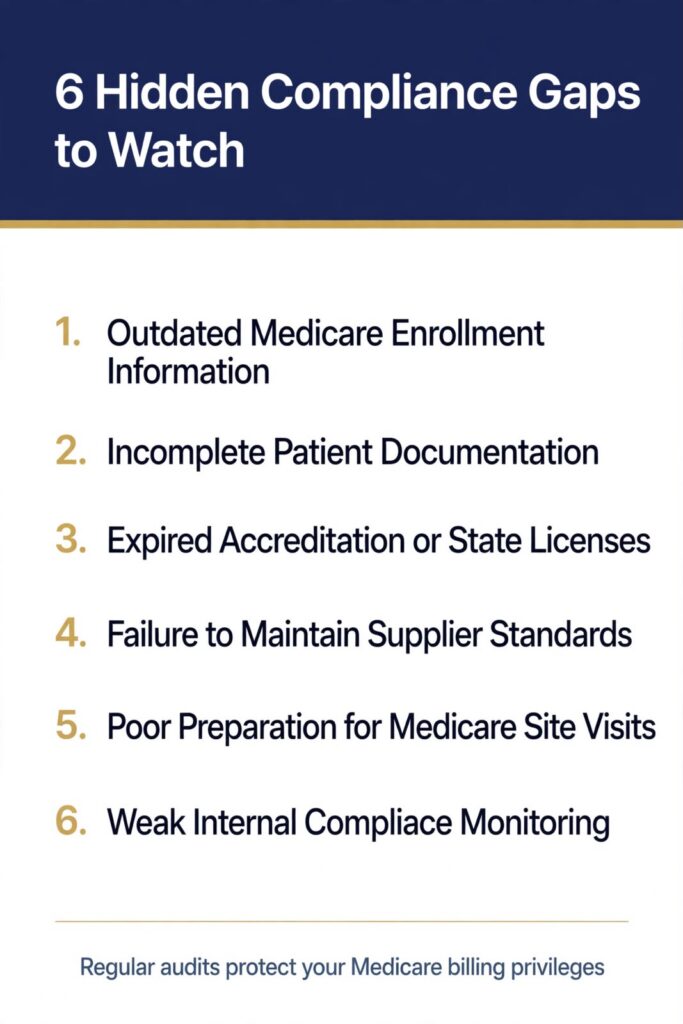
1. Outdated Medicare Enrollment Information
One of the most overlooked compliance issues is failing to update Medicare enrollment information when business details change.
DMEPOS suppliers must report changes to their enrollment application information within 30 days. These changes may include:
- Business ownership or control changes.
- Changes to the business location.
- Updates to authorized officials or managing employees.
- Changes involving licenses or other enrollment-related information.
When enrollment records do not reflect the supplier’s actual business operations, discrepancies may create compliance concerns during reviews or inspections.
Suppliers should regularly review their Provider Enrollment, Chain, and Ownership System (PECOS) records to ensure that the information remains accurate.
2. Incomplete Patient Documentation
Patient documentation is essential for demonstrating that Medicare-billed equipment and supplies meet applicable coverage and payment requirements.
Missing prescriptions, incomplete medical records, incorrect coding, and unavailable proof of delivery can create significant billing risks.
Depending on the item and applicable Medicare requirements, suppliers may need to maintain:
- Standard Written Orders (SWOs).
- Supporting medical record documentation.
- Proof of Delivery (POD).
- Correct coding and billing information.
- Required face-to-face encounter documentation.
Suppliers should establish a consistent documentation review process before submitting claims. Maintaining organized records also makes it easier to respond to Medicare Administrative Contractor (MAC) requests.
3. Expired Accreditation or State Licenses
Accreditation and applicable state licensing are essential elements of DMEPOS supplier compliance.
A supplier may initially meet accreditation requirements but later overlook renewal deadlines or changes in state licensing requirements. This can create gaps between the supplier’s current operations and its Medicare enrollment obligations.
To reduce this risk, businesses should:
- Track accreditation expiration dates.
- Maintain required state licenses.
- Review licensing requirements for every operating location.
- Keep renewal confirmations and supporting records.
- Address accreditation deficiencies promptly.
Accreditation should be treated as an ongoing responsibility rather than a one-time enrollment requirement.
4. Failure to Maintain Supplier Standards
DMEPOS suppliers must comply with the applicable supplier standards under 42 CFR § 424.57(c).
Problems can arise when businesses fail to maintain appropriate business operations, customer service procedures, physical locations, financial records, or other required standards.
For example, an office that is unexpectedly closed during a site visit or a business that cannot demonstrate compliance with applicable operational requirements may attract additional scrutiny.
Management should regularly evaluate business operations against the current Medicare supplier standards.
5. Poor Preparation for Medicare Site Visits
Site visits help Medicare contractors verify that suppliers meet applicable enrollment and operational requirements.
Some businesses prepare only when they receive an inspection notice. This approach can leave important compliance gaps undiscovered.
Common problems include:
- Missing business records.
- Inconsistent office information.
- Staff unfamiliarity with compliance procedures.
- Inaccessible patient documentation.
- Inability to verify business operations.
Suppliers should maintain inspection-ready records and train employees to understand their responsibilities during a site visit.
6. Weak Internal Compliance Monitoring
Even businesses with experienced staff can develop compliance problems when responsibilities are unclear.
Without regular internal reviews, small errors may continue until they become larger operational concerns.
A practical compliance monitoring program should include regular enrollment reviews, documentation audits, license tracking, staff training, and corrective action procedures.
Assigning specific compliance responsibilities to qualified team members can also improve accountability.
How DMEPOS Suppliers Can Reduce Medicare Revocation Risks
Preventing compliance issues requires consistent monitoring and timely corrective action. Suppliers should consider the following practices:
- Conduct periodic internal compliance audits.
- Review PECOS enrollment information.
- Maintain current accreditation and applicable licenses.
- Organize patient and billing documentation.
- Monitor Medicare communications and deadlines.
- Train employees on supplier standards.
- Investigate and correct identified deficiencies.
- Keep evidence of corrective actions and compliance reviews.
If a supplier receives a Medicare revocation notice, it should carefully review the stated regulatory basis and applicable response and appeal deadlines. Professional compliance guidance may help identify the appropriate next steps.
Final Thoughts
Medicare compliance does not end when a DMEPOS supplier receives approval. Maintaining billing privileges requires ongoing attention to enrollment information, accreditation, licensing, documentation, and operational standards.
Hidden compliance gaps can develop gradually, but regular audits and organized procedures can help suppliers identify problems before they become serious. By making compliance part of everyday business operations, DMEPOS suppliers can better protect their Medicare participation and build sustainable businesses.
Frequently Asked Questions (FAQs)
1. What can cause a DMEPOS supplier to lose Medicare billing privileges?
Noncompliance with Medicare supplier standards, enrollment issues, certain licensing problems, and other applicable grounds under federal regulations can result in revocation.
2. How often should DMEPOS suppliers review compliance?
Suppliers should monitor compliance continuously and conduct scheduled internal reviews throughout the year.
3. What is the role of accreditation in DMEPOS compliance?
Accreditation helps demonstrate that a supplier meets applicable quality standards. Suppliers must maintain required accreditation to continue meeting Medicare enrollment requirements.
4. How quickly must DMEPOS suppliers report enrollment changes?
CMS requires DMEPOS suppliers to report changes in their enrollment application information within 30 days.
5. Can missing patient documentation create Medicare billing problems?
Yes. Missing orders, medical records, correct coding information, or proof of delivery can affect claim payment and create audit concerns.
6. How can suppliers prepare for Medicare site visits?
They should maintain accurate business records, keep their locations compliant, organize required documentation, and train employees on inspection procedures.