
start Durable Medical Equipment (DME) industry can be a highly rewarding business opportunity, especially with the growing demand for home healthcare products across the United States. However, before a supplier can legally serve Medicare beneficiaries and submit claims for reimbursement, several regulatory requirements must be met.
Among the most frequently misunderstood requirements are DME Accreditation and NPPES registration. Many new business owners assume these terms refer to the same process, while others mistakenly believe completing one automatically satisfies the other. In reality, they serve entirely different purposes within the Medicare enrollment framework.
Understanding the distinction between DME Accreditation and NPPES is critical for avoiding delays, preventing compliance issues, and establishing a successful Medicare-approved DME business.
In this comprehensive guide, The DME Consultant explains what each requirement means, how they differ, why they matter, and how they fit into the Medicare supplier enrollment process.
Understanding the Foundation of Medicare Supplier Enrollment
Before discussing the differences, it’s important to understand why these requirements exist.
The Centers for Medicare & Medicaid Services (CMS) has established strict standards to ensure that suppliers serving Medicare beneficiaries maintain quality, integrity, and accountability.
To achieve this goal, CMS requires suppliers to:
- Verify their identity
- Demonstrate operational compliance
- Meet quality standards
- Maintain proper documentation
- Follow supplier regulations
DME Accreditation and NPPES help fulfill different parts of these requirements.
What Is DME Accreditation?
DME Accreditation is a formal review process that evaluates whether a Durable Medical Equipment supplier meets specific quality and operational standards required by Medicare.
The accreditation process is conducted by CMS-approved accrediting organizations that assess various aspects of a supplier’s business operations.
The evaluation typically includes:
- Business policies and procedures
- Patient service protocols
- Product handling procedures
- Employee training documentation
- Infection control policies
- Complaint resolution processes
- Compliance programs
- Record-keeping systems
Accreditation demonstrates that a supplier is capable of delivering products and services in accordance with Medicare quality standards.
Why DME Accreditation Matters
DME Accreditation serves as proof that your company operates responsibly and follows industry best practices.
Benefits include:
Medicare Eligibility
Most DME suppliers must become accredited before completing Medicare enrollment.
Increased Credibility
Accreditation helps establish trust with:
- Physicians
- Referral partners
- Insurance companies
- Patients
Better Operational Structure
Accreditation preparation often helps businesses develop stronger internal systems and compliance procedures.
Reduced Compliance Risks
Well-documented processes help minimize regulatory issues and audits.
What Is NPPES?
NPPES stands for National Plan and Provider Enumeration System.
It is the federal system used to issue National Provider Identifiers (NPIs) to healthcare providers and organizations.
An NPI is a unique 10-digit number that identifies healthcare entities during administrative and financial transactions.
Every healthcare provider involved in Medicare-related activities typically requires an NPI.
What Is an NPI Used For?
The National Provider Identifier is used for:
- Medicare enrollment
- Insurance billing
- Electronic healthcare transactions
- Provider identification
- Claims submissions
- Credentialing activities
Think of an NPI as the official identification number assigned to your healthcare business.
However, receiving an NPI does not indicate that your company has met Medicare supplier requirements.
DME Accreditation vs NPPES: The Core Difference
The simplest way to understand the distinction is this:
DME Accreditation evaluates your business.
NPPES identifies your business.
While both are important, they serve completely different functions.
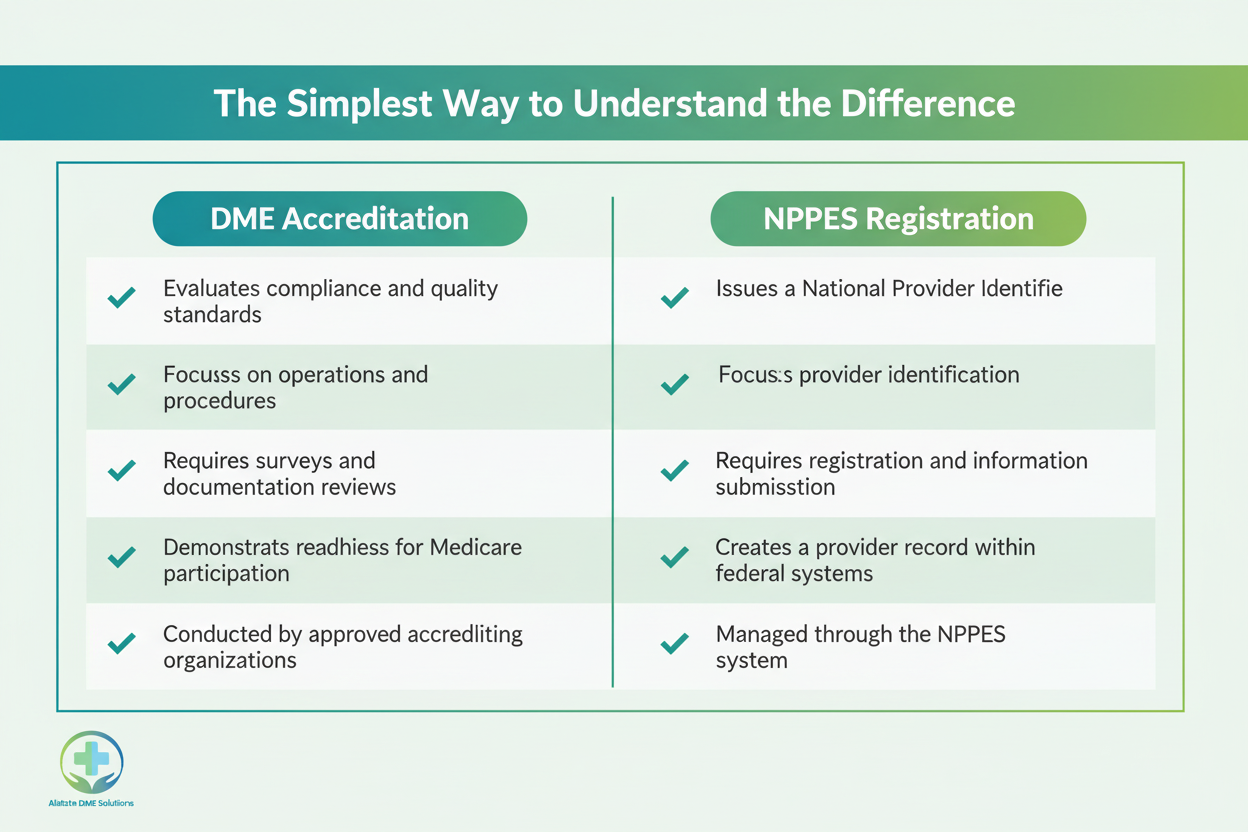
A supplier generally needs both before becoming fully operational within the Medicare system.
Why New Suppliers Often Confuse These Requirements
Several factors contribute to confusion.
Both Are Part of Medicare Enrollment
Because accreditation and NPPES registration are completed during the supplier setup process, many business owners assume they are interchangeable.
Both Involve CMS Requirements
Although CMS oversees the broader Medicare framework, accreditation and NPPES are separate requirements managed differently.
Both Must Be Completed Early
New suppliers often encounter both requirements around the same time, leading to misunderstandings about their individual purposes.
The Medicare Enrollment Journey Explained
Understanding where accreditation and NPPES fit into the process can eliminate confusion.
Step 1: Form Your Business Entity
Before anything else, establish your company legally.
This may include:
- LLC formation
- Corporation registration
- Employer Identification Number (EIN)
- State licensing requirements
Step 2: Obtain an NPI
Register through the NPPES system to receive your National Provider Identifier.
This number will be required for future enrollment activities.
Step 3: Prepare for Accreditation
Develop policies, procedures, and operational systems that meet accreditation standards.
Step 4: Complete Accreditation Review
Undergo inspection and evaluation by a CMS-approved accrediting organization.
Step 5: Secure Required Compliance Elements
Depending on your business model, additional requirements may include:
- Surety bonds
- Business insurance
- Supplier standards compliance
Step 6: Complete Medicare Enrollment
Submit enrollment documentation through Medicare’s supplier enrollment process.
Common Mistakes DME Suppliers Make
Many startup suppliers face avoidable setbacks because they misunderstand regulatory requirements.
Assuming an NPI Equals Medicare Approval
An NPI simply identifies your organization.
It does not authorize billing or Medicare participation.
Delaying Accreditation Preparation
Waiting until the last minute often results in missing documents and compliance gaps.
Using Generic Policies
Accrediting organizations expect policies tailored to your business operations.
Ignoring Ongoing Compliance
Accreditation is not a one-time achievement. Maintaining compliance is equally important.
How Accreditation Supports Long-Term Business Growth
While many suppliers view accreditation as a regulatory hurdle, it can actually strengthen a business in several ways.
Improved Operational Consistency
Documented procedures create a more organized workflow.
Better Patient Experience
Clear service standards help improve customer satisfaction.
Enhanced Referral Relationships
Healthcare providers often prefer working with suppliers that maintain strong compliance records.
Increased Expansion Opportunities
Accredited businesses are often better positioned to pursue contracts and partnerships.
The Role of Professional DME Consulting Services
Navigating Medicare requirements without guidance can be overwhelming.
Many suppliers choose to work with experienced consultants to simplify the process.
Professional DME consulting services can assist with:
- Accreditation preparation
- Policy development
- Medicare enrollment support
- Compliance management
- Documentation review
- Operational readiness assessments
This approach often reduces delays and helps businesses avoid costly mistakes.
Why Suppliers Choose The DME Consultant
The DME Consultant specializes in helping healthcare entrepreneurs navigate the complex world of DME compliance and Medicare enrollment.
Our team assists suppliers through every stage of the process, including:
DME Accreditation Services
We help suppliers prepare for accreditation by developing customized compliance programs and operational documentation.
Medicare Enrollment Assistance
Our experts guide businesses through enrollment requirements and application preparation.
Compliance Support
We help suppliers establish systems that promote long-term regulatory success.
Business Launch Guidance
From startup planning to Medicare readiness, we provide strategic support designed for growth.
Whether you’re opening your first DME company or expanding an existing operation, our goal is to simplify the process and help you move forward with confidence.
The Future of DME Compliance
The healthcare industry continues to evolve rapidly.
Regulators are placing greater emphasis on:
- Quality assurance
- Documentation accuracy
- Fraud prevention
- Patient protection
- Operational transparency
Suppliers who build strong compliance foundations today will be better prepared for future regulatory changes and business growth opportunities.
Understanding the difference between DME Accreditation and NPPES is one of the first steps toward building that foundation.
Conclusion
DME Accreditation and NPPES are both essential components of the Medicare supplier journey, but they serve entirely different purposes.
NPPES provides your National Provider Identifier, allowing healthcare systems to recognize your business. DME Accreditation, on the other hand, verifies that your organization meets Medicare’s quality and operational standards.
Confusing these requirements can lead to delays, application issues, and unnecessary frustration. By understanding how they work together, suppliers can create a smoother path toward Medicare participation and long-term success.
If you’re preparing to launch or grow a DME business, The DME Consultant can help you navigate accreditation, compliance, and Medicare enrollment with expert guidance every step of the way.
Contact The DME Consultant today and take the next step toward becoming a fully compliant Medicare supplier.
Frequently Asked Questions (FAQs)
What is the main difference between DME Accreditation and NPPES?
DME Accreditation evaluates your company’s compliance and quality standards, while NPPES provides your National Provider Identifier (NPI).
Do I need an NPI before Medicare enrollment?
Yes. Most suppliers obtain an NPI before submitting Medicare enrollment applications.
Is accreditation required for all DME suppliers?
Most suppliers seeking Medicare participation must obtain accreditation from a CMS-approved accrediting organization.
Does receiving an NPI allow me to bill Medicare?
No. An NPI is only an identification number and does not grant billing privileges.
How long does DME Accreditation take?
The timeline varies depending on business readiness, documentation quality, and accreditation requirements.