
Starting a DME company sounds simple until the paperwork begins. One missing document can slow your launch. One wrong location choice can create inspection problems. One weak process can delay payer enrollment. That is why a checklist matters. It gives you a clean path before money, time, and energy are wasted. This guide walks through the steps most new suppliers need to understand before opening. It does not replace professional advice, but it helps you think in the right order. If your goal is to start a DME company without delays, you need more than motivation. You need a plan that connects licensing, accreditation, supplier standards, enrollment, documentation, and operations before your first claim is submitted.
Why DME Startups Face Delays
Most DME delays do not happen because the owner lacks effort. They happen because the process has many connected parts. A supplier may complete one step but miss another requirement tied to it.
For example, a business owner may form an LLC and lease a space. That feels like progress. Yet Medicare supplier enrollment may still require proper accreditation, NPI setup, surety bond, documentation systems, and location readiness. If these pieces are not planned together, the launch timeline stretches.
CMS explains that DMEPOS suppliers must meet supplier standards to enroll and keep Medicare billing privileges. CMS also notes that suppliers generally need accreditation and a surety bond unless an exemption applies. These are not small details. They can decide whether your business moves forward or waits.
Many new owners also underestimate documentation. Medicare DMEPOS items need proper orders before claims. Some items require a written order before delivery. Others require the order before claim submission. If your team does not understand this early, denials can start before revenue becomes stable.
Delays are easier to prevent than repair. That is why your setup should begin with order, structure, and realistic timing.
Step 1: Choose the Right DME Business Model
Start with your business model before applying for anything. DME is a broad field. You may focus on mobility equipment, respiratory supplies, diabetic products, orthotics, wound care supplies, or home medical equipment.
Each product category has different rules, inventory needs, delivery expectations, payer requirements, and documentation standards. A supplier that tries to sell everything from day one may create more confusion than growth.
A focused model helps you plan better. It tells you what licenses may apply. It shapes your accreditation scope. It affects payer enrollment. It also helps you build the right referral relationships.
Think about these questions first:
- What products will you provide?
- Who is your ideal patient?
- Will you serve Medicare beneficiaries?
- Will you work with Medicaid or commercial payers?
- Will you deliver equipment locally?
- Will you keep inventory on-site?
- Will you operate from a retail location or office model?
The answers guide every next step. They also help you avoid spending money on items you may not need yet.
Step 2: Register the Business Correctly
Once the model is clear, set up the legal and financial basics. This usually includes business formation, employer identification number, business bank account, local permits, and required insurance.
Your business name and ownership details should be consistent across documents. Small mismatches can create problems during applications. The same address, legal name, tax ID, and ownership information should appear correctly wherever required.
You should also organize your records from the beginning. Keep formation documents, tax records, lease documents, insurance certificates, licenses, and contracts in one secure place. A messy file system can slow applications later.
Many owners rush this stage because it feels basic. In reality, clean business records make credentialing and enrollment smoother. They also make your company look more professional to payers, surveyors, lenders, and referral partners.
Step 3: Check State Licensing Requirements
DME licensing rules can vary by state. Some states require DME suppliers to hold specific licenses. Others may regulate certain product categories more closely.
Do not assume that a general business license is enough. Check your state requirements before signing a lease or buying inventory. If you plan to serve multiple states, check each state separately.
You may also need local zoning approval, sales tax registration, or healthcare-related permits. Requirements depend on your model, location, products, and payer plans.
This step matters because licensing delays can stop the rest of your launch. A payer may ask for a license before approving enrollment. An accrediting organization may review your license status during preparation. A location may need to meet local business rules before use.
The safest approach is to confirm licensing early and keep proof ready.
Step 4: Prepare Your Location Before Inspection
Your location is more than an address. It can affect accreditation, enrollment, inspections, and customer trust.
A DME supplier location should be suitable for the business model. It should support product storage, patient service, documentation, and required business operations. Medicare supplier standards may involve public access, posted hours, signage, and the ability to maintain business records.
Before signing a lease, ask whether the space can support your intended use. Review zoning. Check storage needs. Consider parking, accessibility, delivery flow, and patient access.
A poor location choice can cause expensive problems. You may need changes after signing. You may face delays because signage, layout, or access does not match requirements. You may also discover that the rent is too high for your early revenue stage.
A better approach is to review the location through a compliance lens before committing. This helps you avoid rework and launch delays.
Step 5: Plan Accreditation Early
Accreditation is a major step for many DMEPOS suppliers. CMS states that DMEPOS suppliers generally must be accredited by a CMS-approved accrediting organization unless exempt. Accreditation helps verify that the supplier meets required quality standards.
Do not wait until the end to think about accreditation. It affects policies, procedures, staff training, complaint handling, delivery records, equipment handling, and patient service systems.
Start by choosing an accrediting organization that fits your business model. Then review its standards carefully. You may need written policies, training records, emergency plans, quality controls, patient intake forms, and documentation workflows.
A strong accreditation plan helps you prepare instead of panic. It also creates better habits before your business starts handling patients and claims.
If your goal is to start a DME company without delays, accreditation should be part of your early roadmap, not a last-minute task.
Step 6: Get Your NPI and Surety Bond Ready
A National Provider Identifier is required for many healthcare enrollment steps. CMS guidance for the Medicare DMEPOS supplier application says the supplier obtains the required NPI, surety bond, and accreditation before completing and submitting the application.
DMEPOS suppliers usually need a surety bond of $50,000 for each NPI they maintain, unless an exemption applies. CMS also directs suppliers to use a Treasury-certified surety bond company.
Do not treat the surety bond as a minor formality. It is part of Medicare supplier enrollment readiness. If the bond is missing, wrong, or delayed, the application can be affected.
Keep your NPI, surety bond, accreditation documents, insurance, and business records aligned. Any mismatch in names, addresses, or ownership information can slow review.
This step also shows why timing matters. You cannot submit everything properly if major pieces are still incomplete.
Step 7: Build Your Policies and Procedures
Policies and procedures are not just documents for a binder. They guide how your business operates every day.
Your DME company may need policies for patient intake, complaints, delivery, equipment maintenance, infection control, emergency planning, privacy, billing documentation, staff training, and quality improvement.
Good policies should be clear enough for your team to follow. They should match your real operations. A generic policy that no one uses will not help during a survey or an internal problem.
Use this stage to build practical systems. Decide who handles intake. Decide who checks orders. Decide who verifies coverage. Decide who tracks delivery proof. Decide who follows up on missing documents.
The goal is to reduce confusion before patient orders begin. A clear process protects your staff, patients, and cash flow.
Step 8: Prepare Medicare and Payer Enrollment
Enrollment is one of the biggest delay points for DME startups. Medicare, Medicaid, and commercial payers may require different applications and supporting documents.
CMS identifies the CMS-855S as the Medicare enrollment application for DMEPOS suppliers. Suppliers may also use PECOS for enrollment activity. Before applying, make sure your business information, accreditation, NPI, bond, insurance, licenses, and address details are ready.
Payer enrollment should be planned, not rushed. Create a checklist for each payer. Track what was submitted, when it was sent, who received it, and what follow-up is needed.
Commercial payers may ask for contracts, licenses, accreditation proof, insurance, W-9 forms, ownership details, and service information. Medicaid rules may vary by state.
A clean enrollment process can help your revenue begin sooner. A messy process can delay billing for months.
Step 9: Set Up Billing and Documentation Before Orders Start
Billing should not be built after the first patient order. It should be ready before business begins.
CMS says DMEPOS orders must include required elements. CMS also explains that certain items require a written order before delivery. For other items, the order is required before claim submission. Proof of delivery must also be kept in supplier files for the required retention period.
This means your team needs a clear documentation process. They should know what must be collected before delivery. They should know when prior authorization applies. They should know how to store proof of delivery and order records.
A strong billing setup includes:
- Eligibility verification
- Order review
- Prior authorization tracking
- Delivery documentation
- Claim coding checks
- Denial tracking
- Payment follow-up
- File retention process
This is where many DME startups lose money. They assume demand equals revenue. In DME, revenue depends on clean documentation and correct billing.
Step 10: Choose Vendors and Software Carefully
Your vendors affect service quality, delivery timing, inventory control, and profit margins. Choose suppliers that match your product focus and service area.
Do not only compare price. Look at availability, warranty support, shipping speed, return policy, product training, and reliability. A cheaper vendor can cost more if products arrive late or support is poor.
Software also matters. Your system should support patient records, billing, inventory, delivery tracking, document storage, and reporting. Choose software that fits your company stage. Too much complexity can slow a startup. Too little function can create problems as you grow.
Ask whether the software works with your billing plans. Ask whether staff can learn it easily. Ask whether it helps with compliance records.
The right tools do not replace good process. They make good process easier to follow.
Step 11: Train Your Team Before Launch
Staff training should happen before patients arrive. Every team member should understand their role and the rules that affect it.
Your intake team should know what information to collect. Your billing team should know documentation requirements. Your delivery team should know proof-of-delivery rules. Your managers should know how to monitor compliance.
Training should be documented. Keep records of who was trained, what was covered, and when training happened. This supports accreditation readiness and internal accountability.
A small team still needs structure. In fact, small teams often need it more because one person may handle several responsibilities. Clear training prevents tasks from falling through the cracks.
A trained team helps you start a DME company without delays because fewer errors appear during real operations.
Step 12: Build Referral and Marketing Systems
Once compliance and enrollment are moving, plan your referral strategy. DME companies often grow through relationships with physicians, clinics, discharge planners, therapists, community organizations, and patients.
Your message should be clear. Explain what products you provide, where you serve, how orders are handled, and why referral partners can trust you.
Marketing should never promise services your operation cannot support. If you advertise fast delivery, your inventory and delivery systems must be ready. If you promote Medicare billing, enrollment and documentation must support that claim.
Build a simple referral process. Make it easy for providers to send orders. Give them clear forms, contact details, and response expectations. Track referral sources so you know what is working.
Growth starts smoother when your business can handle the attention it creates.
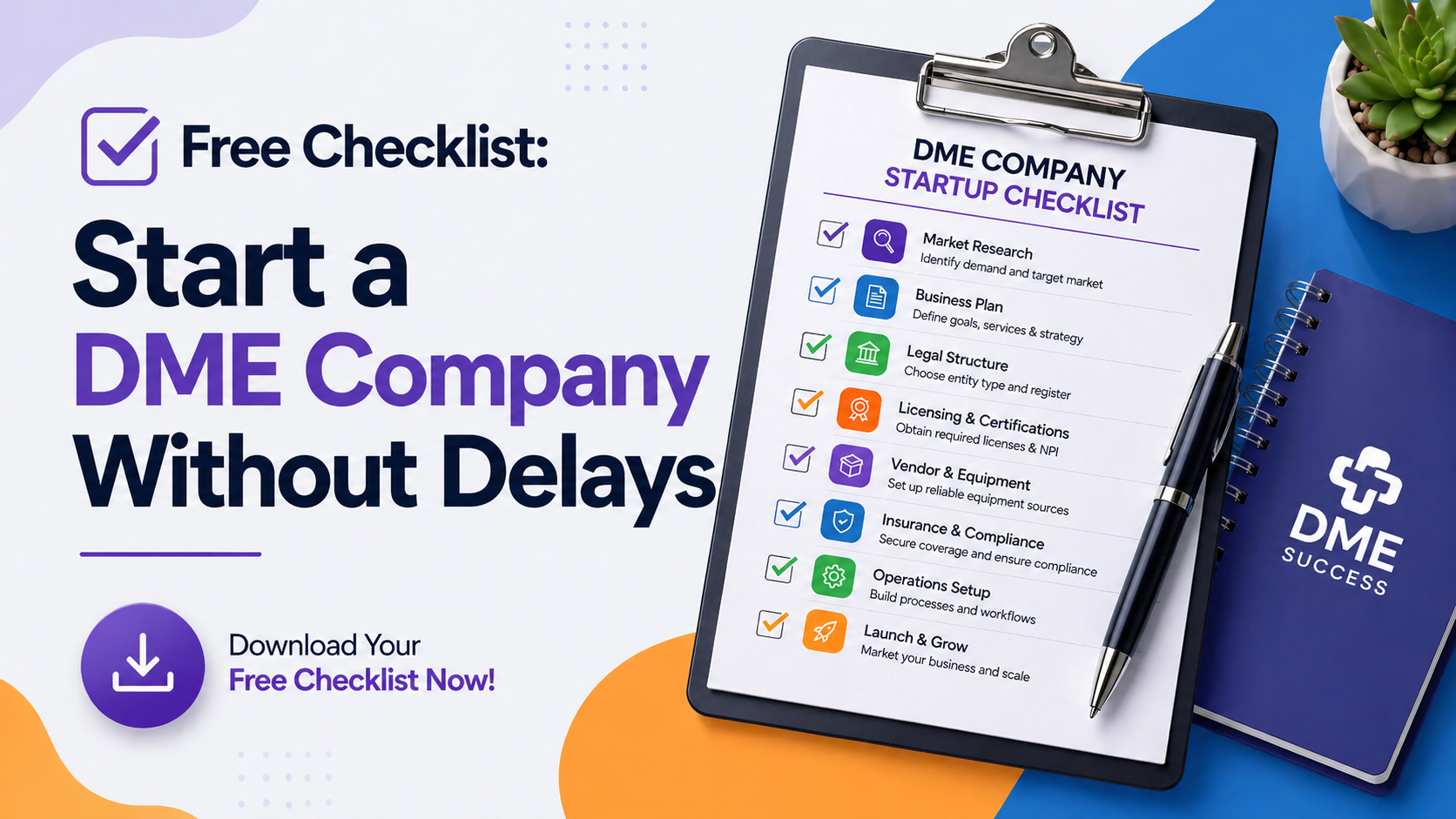
Free DME Startup Checklist
Use this DME startup checklist to review your readiness before launch:
- Choose your DME product focus
- Confirm your business model
- Form your legal business entity
- Get your EIN and business bank account
- Check state licensing requirements
- Review zoning and location suitability
- Prepare your lease and site setup
- Choose an accrediting organization
- Build policies and procedures
- Apply for your NPI
- Obtain required insurance
- Arrange your surety bond if needed
- Prepare accreditation documents
- Set up billing software
- Create order documentation workflows
- Prepare Medicare enrollment documents
- Review Medicaid and commercial payer needs
- Choose vendors and inventory sources
- Train staff before launch
- Set up proof-of-delivery procedures
- Build referral and marketing materials
- Track deadlines and follow-ups
This checklist will not remove every challenge. It gives you a practical way to find weak points before they become delays.
Common Mistakes That Slow New DME Companies
The first mistake is starting without a clear niche. Too many product categories can create confusion in accreditation, billing, inventory, and training.
The second mistake is signing a lease too fast. A poor location can create compliance or inspection problems. It can also strain your budget before revenue begins.
The third mistake is delaying accreditation planning. If policies, procedures, and training are not ready, the survey process can become stressful.
The fourth mistake is weak documentation. Missing orders, incomplete files, and poor proof of delivery can lead to denials.
The fifth mistake is ignoring cash flow timing. Enrollment and reimbursement can take time. Owners should plan enough working capital to survive the early stage.
The sixth mistake is treating compliance as paperwork. Compliance is daily behavior. It affects intake, delivery, billing, complaints, records, and patient service.
Avoiding these mistakes can help you start a DME company without delays and build a stronger business from day one.
Final Thoughts
Starting a DME company takes more than a product list and a business name. It takes planning, compliance, documentation, payer readiness, and trained staff. The businesses that launch smoother usually prepare the boring details early.
A checklist gives you control. It helps you see what is ready and what still needs work. It also keeps your setup in the right order.
Do not rush the foundation. Choose your niche. Prepare the location. Plan accreditation. Get your NPI and bond ready. Build clean policies. Set up billing before orders begin. Train your team before launch.
When those pieces work together, your business has a better chance to open smoothly. It also has a stronger chance to grow without repeated setbacks.
The best way to start a DME company without delays is to plan before the pressure begins. That is how you save time, protect cash flow, and build a company ready for long-term success.